分享兴趣,传播快乐,
增长见闻,留下美好!
亲爱的您,这里是LearningYard新学苑。
今天小编为大家带来文章
“刘心向学(58):itertools —— 迭代器的瑞士军刀”
欢迎您的访问。
Share interest, spread happiness,
Increase knowledge, leave a beautiful!
Dear, this is LearningYard Academy.
Today, the editor brings you an article.
“Liu Xin Xiang Xue (58): itertools — The Swiss Army Knife of Iterators”
Welcome to your visit.
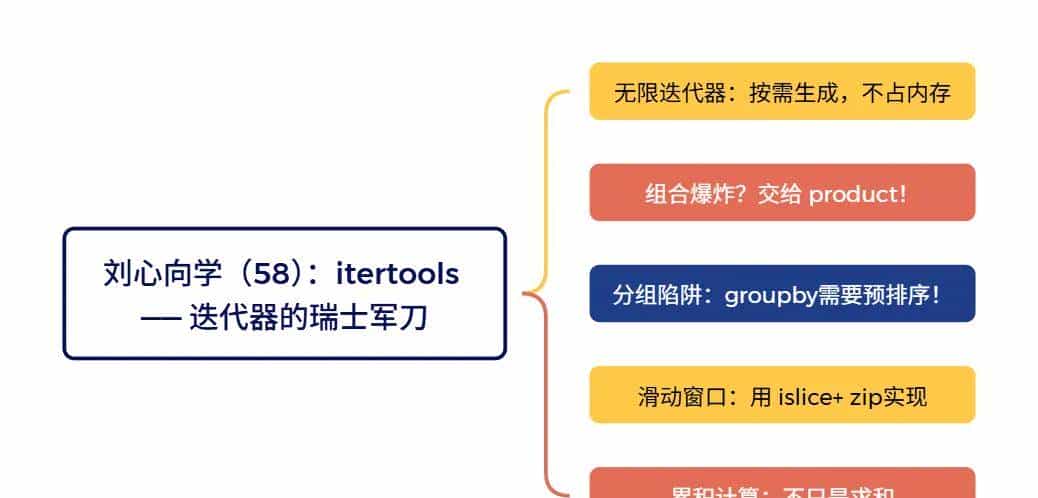
一、思维导图(Mind Map)
二、引言(Introduction)
在 Python 中,“一切皆可迭代”。
In Python, “everything is iterable.”
但当你需要组合、切片、分组或无限生成数据时,手写循环往往冗长、易错且低效。
But when you need to combine, slice, group, or generate infinite sequences, hand-written loops often become verbose, error-prone, and inefficient.
这时,标准库中的 itertools 模块便大显身手。
That’s where the standard library’s itertools module shines.
它提供了一系列高性能、内存友善的迭代器构建工具,让你用函数式风格优雅地处理序列。
It provides a collection of high-performance, memory-efficient iterator building blocks that let you handle sequences with functional elegance.
无需额外依赖,一行代码替代多层嵌套——这才是 Pythonic 的迭代之道。
No external dependencies. One line replaces nested loops. This is the truly Pythonic way to iterate.
三、无限迭代器:按需生成,不占内存(Infinite Iterators: Generate On Demand, Zero Memory Overhead)
Python编辑1from itertools import count, cycle, repeat
2
3# 无限计数:0, 1, 2, ...
4for i in count():
5if i >5:break
6print(i)
7
8# 循环播放列表
9for color in cycle(['red','green','blue']):
10print(color)
11# 需手动 break
12
13# 重复 "hello" 3 次
14list(repeat('hello',3))# ['hello', 'hello', 'hello']
所有 itertools 返回的是迭代器,惰性求值,内存占用恒定。
All itertools functions return iterators—lazy evaluation means constant memory usage regardless of data size.
四、组合爆炸?交给 product!(Combinatorial Explosion? Let product()Handle It!)
Python编辑1from itertools import product
2
3# 模拟配置组合测试
4os_list =['Windows','Linux']
5browser_list =['Chrome','Firefox']
6
7for os, browser in product(os_list, browser_list):
8print(f"Testing on {os} + {browser}")
输出:
Output:
Text编辑1Testing on Windows + Chrome
2Testing on Windows + Firefox
3Testing on Linux + Chrome
4Testing on Linux + Firefox
等价于嵌套 for 循环,但更简洁、可扩展。
This replaces nested for loops with clean, scalable code.
五、分组陷阱:groupby需要预排序!(The groupbyGotcha: Always Sort First!)
Python编辑1from itertools import groupby
2
3data =[
4{'name':'Alice','dept':'HR'},
5{'name':'Bob','dept':'Eng'},
6{'name':'Charlie','dept':'HR'}
7]
8
9# 错误:未排序 → 分成三组!
10for dept, group in groupby(data, key=lambda x: x['dept']):
11print(dept,list(group))
12
13# 正确做法:先按 dept 排序
14sorted_data =sorted(data, key=lambda x: x['dept'])
15for dept, group in groupby(sorted_data, key=lambda x: x['dept']):
16print(dept,[p['name']for p in group])
输出:
Text编辑1Eng ['Bob']
2HR ['Alice', 'Charlie']
groupby 仅对连续一样键分组,类似 Unix 的 uniq。
groupby only groups consecutive identical keys—just like Unix uniq. Pre-sorting is essential.
六、滑动窗口:用 islice+ zip实现(Sliding Window: Build with islice+zip)
Python编辑1from itertools import islice
2
3defsliding_window(seq, n=2):
4    iterators =[islice(seq, i,None)for i inrange(n)]
5returnzip(*iterators)
6
7list(sliding_window([1,2,3,4,5],3))
8# [(1, 2, 3), (2, 3, 4), (3, 4, 5)]
适用于时间序列、N-gram 生成等场景。
Perfect for time-series analysis, N-gram generation, or moving averages.
七、累积计算:不只是求和(Accumulation Beyond Summation)
Python编辑1from itertools import accumulate
2import operator
3
4nums =[1,2,3,4]
5
6# 默认累加
7list(accumulate(nums))# [1, 3, 6, 10]
8
9# 累积乘积
10list(accumulate(nums, func=operator.mul))# [1, 2, 6, 24]
八、最佳实践(Best Practices)
优先使用 itertools 而非手写循环:更高效、更少 bug
Prefer itertools over manual loops: more efficient, fewer bugs
结合 map/filter/生成器表达式构建数据流水线
Chain with map, filter, or generator expressions to build data pipelines
注意惰性求值:迭代器只能消费一次
Remember iterators are consumed once: reuse requires recreation
调试技巧:用 list() 查看内容(仅用于小数据)
Debugging tip: wrap in list() to inspect (only for small data!)
九、结语(Conclusion)
itertools 是 Python 标准库中最被低估的宝藏之一。
itertools is one of the most underappreciated gems in Python’s standard library.
它把常见的迭代模式抽象为可组合的构建块,让你写出既快又短的代码。
It abstracts common iteration patterns into composable, high-performance tools—helping you write code that’s both faster and shorter.
从今天起,当你面对多重循环、排列组合或分组逻辑时,请问自己:
From now on, whenever you face nested loops, combinatorics, or grouping logic, ask yourself:
“itertools 有没有现成的工具?”
“Does itertools already have a tool for this?”
答案,往往就在那里——安静、高效、等待被你发现。
The answer is often yes—quiet, efficient, and ready to use.
由于真正的简洁,不是少写几行代码,而是用正确的抽象消除复杂性。
Because true simplicity isn’t about writing fewer lines—it’s about eliminating complexity through the right abstraction.
而 itertools,正是那个帮你做到这一点的利器。
And itertools is precisely that kind of tool.
今天的分享就到这里了。
如果您对文章有独特的想法,
欢迎给我们留言,
让我们相约明天。
祝您今天过得开心快乐!
That's all for today's sharing.
If you have a unique idea about the article,
please leave us a message,
and let us meet tomorrow.
I wish you a nice day!
参考资料:通义千问
参考文献:Beazley, D., & Jones, B. K. (2019). Python Cookbook (3rd ed.). O'Reilly Media.
Hettinger, R. (2019). Transforming Code into Beautiful, Idiomatic Python. PyCon US.
本文由LearningYard新学苑整理发出,如有侵权请在后台留言沟通!
LearningYard新学苑
文字:song
排版:song
审核|qiu
© 版权声明
文章版权归作者所有,未经允许请勿转载。
相关文章





暂无评论...