lingu=language 表明“语言”,原意为“舌头”
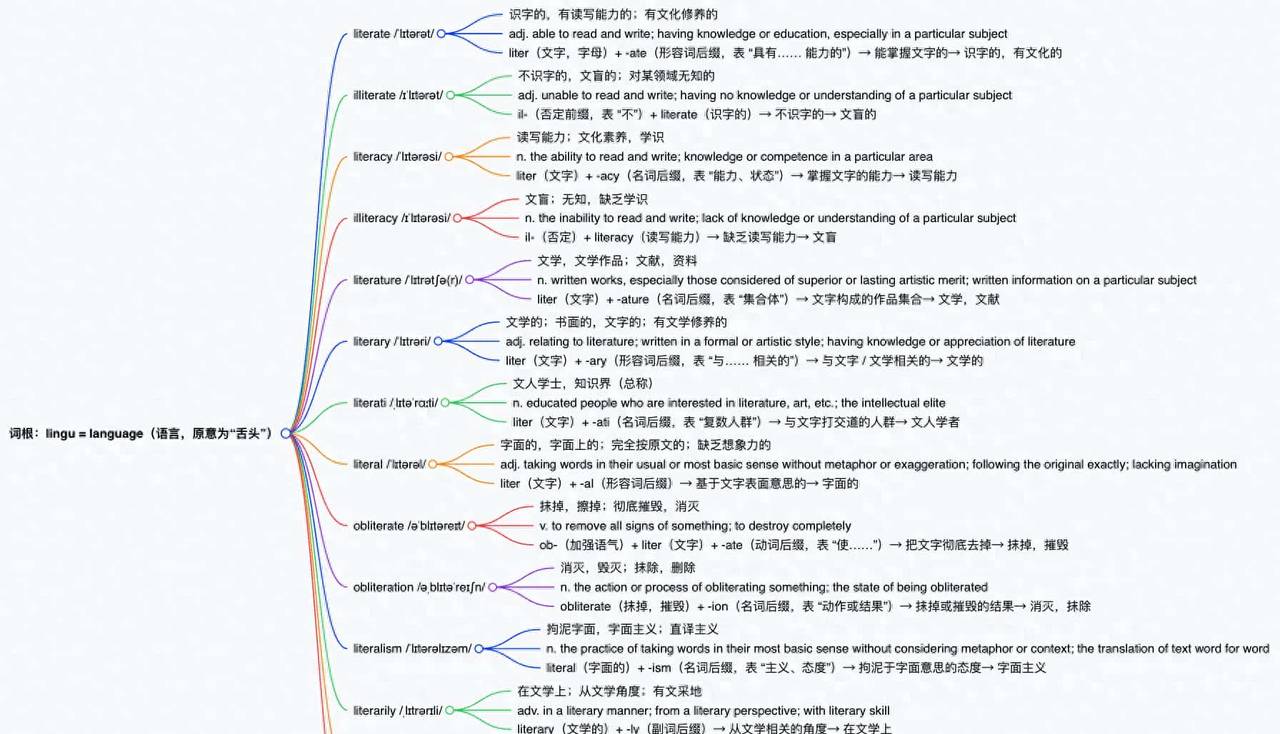
- literate /ˈlɪtərət/
中文释义: 识字的,有读写能力的;有文化修养的。
英文释义: adj. able to read and write; having knowledge or education, especially in a particular subject.
构词: liter(文字,字母)+ -ate(形容词后缀,表 “具有…… 能力的”)→ 能掌握文字的→ 识字的,有文化的。
例句: In modern society, most people are literate and can use digital devices.(在现代社会,大多数人都有读写能力,且会使用数字设备。)/ She is literate in art history and often writes reviews.(她在艺术史方面有修养,常常撰写评论。) - illiterate /ɪˈlɪtərət/
中文释义: 不识字的,文盲的;对某领域无知的。
英文释义: adj. unable to read and write; having no knowledge or understanding of a particular subject.
构词: il-(否定前缀,表 “不”)+ literate(识字的)→ 不识字的→ 文盲的。
例句: The government launched a program to help illiterate adults learn to read.(政府推出了一项计划,协助文盲成年人学习阅读。)/ He is illiterate in computer skills and needs basic training.(他在电脑技能方面一窍不通,需要基础培训。) - literacy /ˈlɪtərəsi/
中文释义: 读写能力;文化素养,学识。
英文释义: n. the ability to read and write; knowledge or competence in a particular area.
构词: liter(文字)+ -acy(名词后缀,表 “能力、状态”)→ 掌握文字的能力→ 读写能力。
例句: Improving digital literacy is essential for adapting to the information age.(提高数字素养对于适应信息时代至关重大。)/ The school focuses on developing students’ literacy in both Chinese and English.(这所学校注重培养学生的中英文读写能力。) - illiteracy /ɪˈlɪtərəsi/
中文释义: 文盲;无知,缺乏学识。
英文释义: n. the inability to read and write; lack of knowledge or understanding of a particular subject.
构词: il-(否定)+ literacy(读写能力)→ 缺乏读写能力→ 文盲。
例句: The campaign aims to eliminate illiteracy in rural areas.(这项运动旨在消除农村地区的文盲现象。)/ His illiteracy in financial management led to serious debts.(他在财务管理方面的无知导致了严重的债务。) - literature /ˈlɪtrətʃə(r)/
中文释义: 文学,文学作品;文献,资料。
英文释义: n. written works, especially those considered of superior or lasting artistic merit; written information on a particular subject.
构词: liter(文字)+ -ature(名词后缀,表 “集合体”)→ 文字构成的作品集合→ 文学,文献。
例句: She majors in comparative literature and studies works from different countries.(她主修比较文学,研究不同国家的作品。)/ The report includes relevant literature on environmental protection.(这份报告包含了相关的环保文献资料。) - literary /ˈlɪtrəri/
中文释义: 文学的;书面的,文字的;有文学修养的。
英文释义: adj. relating to literature; written in a formal or artistic style; having knowledge or appreciation of literature.
构词: liter(文字)+ -ary(形容词后缀,表 “与…… 相关的”)→ 与文字 / 文学相关的→ 文学的。
例句: The author won a literary award for her latest novel.(这位作家凭借最新小说获得了文学奖项。)/ We need to use more literary language in the formal report.(我们需要在正式报告中使用更书面化的语言。) - literati /ˌlɪtəˈrɑːti/
中文释义: 文人学士,知识界(总称)。
英文释义: n. educated people who are interested in literature, art, etc.; the intellectual elite.
构词: liter(文字)+ -ati(名词后缀,表 “复数人群”)→ 与文字打交道的人群→ 文人学者。
例句: The conference was attended by literati and artists from all over the country.(来自全国各地的文人学士和艺术家出席了这次会议。) - literal /ˈlɪtərəl/
中文释义: 字面的,字面上的;完全按原文的;缺乏想象力的。
英文释义: adj. taking words in their usual or most basic sense without metaphor or exaggeration; following the original exactly; lacking imagination.
构词: liter(文字)+ -al(形容词后缀)→ 基于文字表面意思的→ 字面的。
例句: Don’t take his words too literally—he was just joking.(别把他的话太当真,他只是在开玩笑。)/ The literal translation of this phrase doesn’t convey its cultural meaning.(这个短语的直译无法传达其文化内涵。) - obliterate /əˈblɪtəreɪt/
中文释义: 抹掉,擦掉;彻底摧毁,消灭。
英文释义: v. to remove all signs of something; to destroy completely.
构词: ob-(加强语气)+ liter(文字)+ -ate(动词后缀,表 “使……”)→ 把文字彻底去掉→ 抹掉,摧毁。
例句: The heavy rain obliterated the footprints on the ground.(大雨抹去了地上的脚印。)/ The ancient city was obliterated by the earthquake.(这座古城在地震中被彻底摧毁。) - obliteration /əˌblɪtəˈreɪʃn/
中文释义: 消灭,毁灭;抹除,删除。
英文释义: n. the action or process of obliterating something; the state of being obliterated.
构词: obliterate(抹掉,摧毁)+ -ion(名词后缀,表 “动作或结果”)→ 抹掉或摧毁的结果→ 消灭,抹除。
例句: The obliteration of the old town was a great loss to cultural heritage.(老城区的消失是文化遗产的重大损失。) - literalism /ˈlɪtərəlɪzəm/(增补词)
中文释义: 拘泥字面,字面主义;直译主义。
英文释义: n. the practice of taking words in their most basic sense without considering metaphor or context; the translation of text word for word.
构词: literal(字面的)+ -ism(名词后缀,表 “主义、态度”)→ 拘泥于字面意思的态度→ 字面主义。
例句: Biblical literalism is the belief that every word in the Bible is literally true.(圣经字面主义是指信任圣经中的每一个字都是字面上的真理。) - literarily /ˌlɪtrərɪli/(增补词)
中文释义: 在文学上;从文学角度;有文采地。
英文释义: adv. in a literary manner; from a literary perspective; with literary skill.
构词: literary(文学的)+ -ly(副词后缀)→ 从文学相关的角度→ 在文学上。
例句: This novel is literarily significant but not very popular among ordinary readers.(这部小说在文学上具有重大意义,但在普通读者中并不太受欢迎。) - alliterate /əˈlɪtəreɪt/(增补词)
中文释义: 押头韵(即相邻单词首字母发音一样)。
英文释义: v. (of words or phrases) have the same initial consonant sound and be close together in a sentence.
构词: al-(加强)+ liter(字母)+ -ate(动词后缀)→ 强调字母发音的一致性→ 押头韵。
例句: The phrase “safe and sound” alliterates with the repeated “s” sound.(短语 “safe and sound” 以重复的 “s” 音押头韵。) - literacy rate /ˈlɪtərəsi reɪt/(增补常用短语)
中文释义: 识字率,文化普及率。
英文释义: n. the percentage of people in a country or area who can read and write.
构词: literacy(读写能力)+ rate(比率)→ 具备读写能力的人口比例→ 识字率。
例句: The literacy rate in this region has increased from 70% to 95% in the past 20 years.(过去 20 年,该地区的识字率从 70% 提高到了 95%。
一、特别说明
- 词根含义的延伸:
“liter” 核心为 “文字,字母”,可引申为 “读写能力”(如 literate、literacy)、“文学作品”(如 literature、literary)、“字面意思”(如 literal),甚至通过 “去除文字” 引申为 “摧毁”(如 obliterate),覆盖 “文字相关的能力、作品、含义、动作” 四大维度,记忆时可按此分类串联。 - 多义单词的语境区分:
“literature” 既指 “文学作品”(如 classic literature 经典文学),也指 “某领域的文献资料”(如 scientific literature 科学文献),需结合搭配判断含义;
“literal” 表 “字面的” 时为中性(如 literal meaning 字面意思),表 “缺乏想象力的” 时为贬义(如 a literal mind 缺乏想象力的头脑),需注意情感色彩。 - 易混淆同源词:
“literary”(文学的)与 “literal”(字面的)拼写相近但含义完全不同,可通过后缀区分 ——“-ary” 表 “与…… 相关的”(文学相关),“-al” 表 “本质属性”(文字本质 = 字面的)。
二、记忆方法
- 词根 + 后缀联动记忆:
通过后缀判断单词的词性和核心含义,快速推导:
表 “能力 / 状态”:liter + -ate(能…… 的)→ literate(识字的);liter + -acy(能力)→ literacy(读写能力);
表 “作品 / 相关”:liter + -ature(集合体)→ literature(文学作品);liter + -ary(相关的)→ literary(文学的);
表 “动作 / 结果”:ob-(加强)+ liter + -ate → obliterate(抹掉文字→摧毁);literal + -ism → literalism(字面主义)。 - 反义词成对记忆:
将 “肯定 – 否定” 含义的单词绑定,强化对比:
literate(识字的)— illiterate(文盲的);literacy(读写能力)— illiteracy(文盲);
可通过 “il-” 否定前缀快速联想反义词,减少记忆负担。 - 场景化联想记忆:
结合生活或专业场景绑定单词,例如:教育场景:literacy rate(识字率)、illiteracy elimination(扫盲);文学场景:literature(文学作品)、literary award(文学奖项)、alliterate(押头韵);日常表达:literal translation(直译)、obliterate footprints(抹去脚印)。
三、注意点
- 发音细节:
“liter” 部分发音为 /ˈlɪtə/,注意 “t” 和 “e” 的轻读,不可重读为 /ˈlɪtər/;
“obliterate” 发音为 /əˈblɪtəreɪt/(重音在第二音节),“literature” 发音为 /ˈlɪtrətʃə(r)/(重音在首音节),避免重音位置错误。 - 拼写易错点:
“literature” 易漏写 “r”(误写为 “literature”),“obliterate” 易漏写 “e”(误写为 “obliterate”),记忆时可拆分 “词根 + 后缀” 逐步确认(如 liter + ature → literature);
“alliterate” 注意前缀是 “al-” 而非 “a-”,避免拼写错误。 - 使用语境限制:
“literati” 为书面语,多用于描述 “文人学者群体”,日常交流中可用 “intellectuals”(知识分子)替代;
“literalism”“alliterate” 属于专业术语(前者为文学 / 哲学术语,后者为语言学术语),非专业场景较少使用;
“obliterate” 语气较强,表 “摧毁” 时多用于描述彻底破坏(如战争、自然灾害),日常描述 “擦掉字迹” 可用 “erase” 更自然。
© 版权声明
文章版权归作者所有,未经允许请勿转载。
相关文章




暂无评论...