duc,duct=lead,bring,表明“引导,带来”
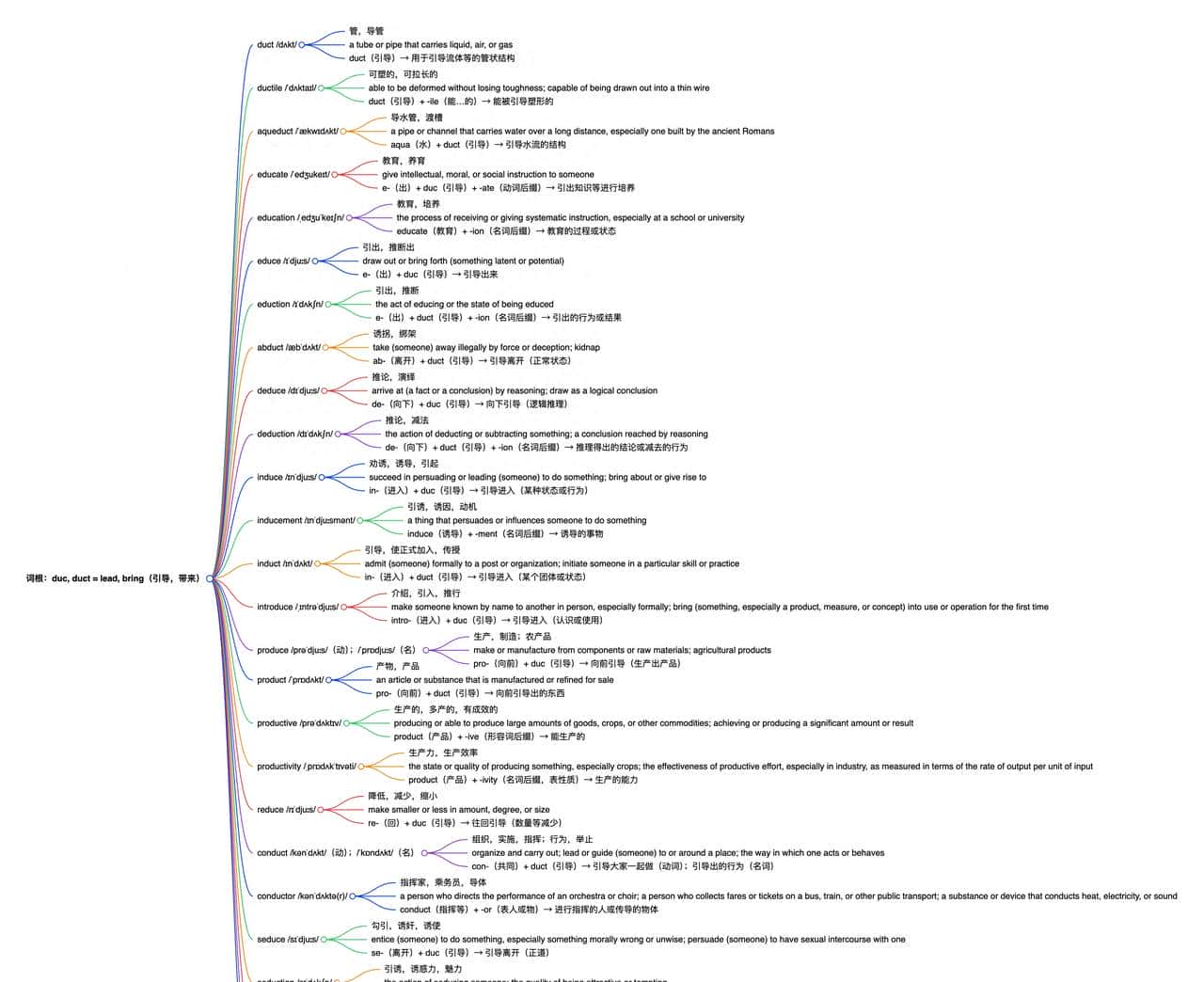
- duct /dʌkt/
中文释义:管,导管。
英文释义:a tube or pipe that carries liquid, air, or gas.
构词:duct(引导)→ 用于引导流体等的管状结构。
例句:The air is circulated through a system of ducts.(空气通过一套管道系统循环。) - ductile /ˈdʌktaɪl/
中文释义:可塑的,可拉长的。
英文释义:able to be deformed without losing toughness; capable of being drawn out into a thin wire.
构词:duct(引导)+ -ile(能… 的)→ 能被引导塑形的。
例句:Gold is a ductile metal that can be hammered into thin sheets.(黄金是一种可塑金属,能被锤成薄片。) - aqueduct /ˈækwɪdʌkt/
中文释义:导水管,渡槽。
英文释义:a pipe or channel that carries water over a long distance, especially one built by the ancient Romans.
构词:aqua(水)+ duct(引导)→ 引导水流的结构。
例句:The ancient aqueduct supplied water to the entire city.(这座古老的渡槽为整座城市供水。) - educate /ˈedʒukeɪt/
中文释义:教育,养育。
英文释义:give intellectual, moral, or social instruction to someone.
构词:e-(出)+ duc(引导)+ -ate(动词后缀)→ 引出知识等进行培养。
例句:Schools aim to educate children to become responsible citizens.(学校旨在教育孩子成为有责任感的公民。) - education /ˌedʒuˈkeɪʃn/
中文释义:教育,培养。
英文释义:the process of receiving or giving systematic instruction, especially at a school or university.
构词:educate(教育)+ -ion(名词后缀)→ 教育的过程或状态。
例句:A good education is essential for personal development.(良好的教育对个人发展至关重大。) - educe /ɪˈdjuːs/
中文释义:引出,推断出。
英文释义:draw out or bring forth (something latent or potential).
构词:e-(出)+ duc(引导)→ 引导出来。
例句:The teacher tried to educe the students' creativity through various activities.(老师尝试通过各种活动激发学生的创造力。) - eduction /ɪˈdʌkʃn/
中文释义:引出,推断。
英文释义:the act of educing or the state of being educed.
构词:e-(出)+ duct(引导)+ -ion(名词后缀)→ 引出的行为或结果。
例句:The eduction of conclusions from the data took several weeks.(从数据中推断结论花了几周时间。) - abduct /æbˈdʌkt/
中文释义:诱拐,绑架。
英文释义:take (someone) away illegally by force or deception; kidnap.
构词:ab-(离开)+ duct(引导)→ 引导离开(正常状态)。
例句:The child was abducted from the park yesterday.(那个孩子昨天在公园被诱拐了。) - deduce /dɪˈdjuːs/
中文释义:推论,演绎。
英文释义:arrive at (a fact or a conclusion) by reasoning; draw as a logical conclusion.
构词:de-(向下)+ duc(引导)→ 向下引导(逻辑推理)。
例句:From the evidence, we can deduce that he was present at the scene.(从证据中我们可以推断他当时在现场。) - deduction /dɪˈdʌkʃn/
中文释义:推论,减法。
英文释义:the action of deducting or subtracting something; a conclusion reached by reasoning.
构词:de-(向下)+ duct(引导)+ -ion(名词后缀)→ 推理得出的结论或减去的行为。
例句:Her deduction that the plan would fail proved correct.(她关于计划会失败的推论被证明是正确的。) - induce /ɪnˈdjuːs/
中文释义:劝诱,诱导,引起。
英文释义:succeed in persuading or leading (someone) to do something; bring about or give rise to.
构词:in-(进入)+ duc(引导)→ 引导进入(某种状态或行为)。
例句:The medicine can induce sleep within minutes.(这种药能在几分钟内使人入睡。) - inducement /ɪnˈdjuːsmənt/
中文释义:引诱,诱因,动机。
英文释义:a thing that persuades or influences someone to do something.
构词:induce(诱导)+ -ment(名词后缀)→ 诱导的事物。
例句:The promise of a bonus was an inducement to work harder.(奖金的承诺是努力工作的诱因。) - induct /ɪnˈdʌkt/
中文释义:引导,使正式加入,传授。
英文释义:admit (someone) formally to a post or organization; initiate someone in a particular skill or practice.
构词:in-(进入)+ duct(引导)→ 引导进入(某个团体或状态)。
例句:He was inducted into the Hall of Fame last year.(他去年被正式引入名人堂。) - introduce /ˌɪntrəˈdjuːs/
中文释义:介绍,引入,推行。
英文释义:make someone known by name to another in person, especially formally; bring (something, especially a product, measure, or concept) into use or operation for the first time.
构词:intro-(进入)+ duc(引导)→ 引导进入(认识或使用)。
例句:Let me introduce my colleague, Sarah.(让我介绍一下我的同事萨拉。) - produce /prəˈdjuːs/ (动词);/ˈprɒdjuːs/(名词)
中文释义:生产,制造;农产品。
英文释义:make or manufacture from components or raw materials; agricultural products.
构词:pro-(向前)+ duc(引导)→ 向前引导(生产出产品)。
例句:This factory produces cars for the European market.(这家工厂为欧洲市场生产汽车。);The farm sells its own produce.(这家农场出售自己的农产品。) - product /ˈprɒdʌkt/
中文释义:产物,产品。
英文释义:an article or substance that is manufactured or refined for sale.
构词:pro-(向前)+ duct(引导)→ 向前引导出的东西。
例句:The new product has been well received by consumers.(这款新产品受到了消费者的好评。) - productive /prəˈdʌktɪv/
中文释义:生产的,多产的,有成效的。
英文释义:producing or able to produce large amounts of goods, crops, or other commodities; achieving or producing a significant amount or result.
构词:product(产品)+ -ive(形容词后缀)→ 能生产的。
例句:The meeting was very productive and we made several important decisions.(会议很有成效,我们做出了几项重大决定。) - productivity /ˌprɒdʌkˈtɪvəti/
中文释义:生产力,生产效率。
英文释义:the state or quality of producing something, especially crops; the effectiveness of productive effort, especially in industry, as measured in terms of the rate of output per unit of input.
构词:product(产品)+ -ivity(名词后缀,表性质)→ 生产的能力。
例句:New technology has improved productivity in the workplace.(新技术提高了工作场所的生产效率。) - reduce /rɪˈdjuːs/
中文释义:降低,减少,缩小。
英文释义:make smaller or less in amount, degree, or size.
构词:re-(回)+ duc(引导)→ 往回引导(数量等减少)。
例句:We need to reduce our carbon emissions to protect the environment.(我们需要减少碳排放以保护环境。) - conduct /kənˈdʌkt/(动词);/ˈkɒndʌkt/(名词)
中文释义:组织,实施,指挥;行为,举止。
英文释义:organize and carry out; lead or guide (someone) to or around a place; the way in which one acts or behaves.
构词:con-(共同)+ duct(引导)→ 引导大家一起做(动词);引导出的行为(名词)。
例句:She conducted the experiment with great care.(她超级认真地进行了实验。);His conduct at the party was unacceptable.(他在聚会上的行为令人无法接受。) - conductor /kənˈdʌktə(r)/
中文释义:指挥家,乘务员,导体。
英文释义:a person who directs the performance of an orchestra or choir; a person who collects fares or tickets on a bus, train, or other public transport; a substance or device that conducts heat, electricity, or sound.
构词:conduct(指挥等)+ -or(表人或物)→ 进行指挥的人或传导的物体。
例句:The orchestra played beautifully under the direction of the conductor.(在指挥家的指挥下,管弦乐队演奏得很美妙。) - seduce /sɪˈdjuːs/
中文释义:勾引,诱奸,诱使。
英文释义:entice (someone) to do something, especially something morally wrong or unwise; persuade (someone) to have sexual intercourse with one.
构词:se-(离开)+ duc(引导)→ 引导离开(正道)。
例句:He was seduced by the offer of a high salary and left his previous job.(他被高薪诱惑,辞去了原来的工作。) - seduction /sɪˈdʌkʃn/
中文释义:引诱,诱惑力,魅力。
英文释义:the action of seducing someone; the quality of being attractive or tempting.
构词:se-(离开)+ duct(引导)+ -ion(名词后缀)→ 引诱的行为或魅力。
例句:The seduction of a life of luxury led him astray.(奢华生活的诱惑使他误入歧途。) - traduce /trəˈdjuːs/
中文释义:诽谤,中伤。
英文释义:speak badly of or tell lies about (someone) so as to damage their reputation.
构词:tra-(横)+ duc(引导)→ 向横引导(歪曲实际)。
例句:He was accused of traducing his former colleague in order to get the job.(他被指控为了得到这份工作而诽谤前同事。) - viaduct /ˈvaɪədʌkt/
中文释义:高架桥,高架铁路(或公路)桥。
英文释义:a long bridge-like structure, typically a series of arches, carrying a road or railway across a valley or other low ground.
构词:via(路)+ duct(引导)→ 引导道路的结构。
例句:The train passed over a viaduct that spanned the river.(火车驶过一座横跨河流的高架桥。) - ventiduct /ˈventɪdʌkt/
中文释义:通风道,风道。
英文释义:a duct for carrying air, especially one used for ventilation.
构词:venti(通风,来自 vent “风”)+ duct(引导)→ 引导风的通道。
例句:The old building's ventiduct system needed to be replaced to improve air circulation.(这座旧建筑的通风道系统需要更换以改善空气流通。)
备注说明:
- 词根 “duc, duct” 的含义是 “引导,带来”,以上单词均围绕这一核心含义通过不同前缀、后缀组合而成,体现了 “引导” 在不同场景下的具体含义(如引导水流、引导思想、引导行为等)。
- 部分单词存在词性变化(如 produce 有动词和名词词性),音标也会因词性不同而略有差异,使用时需注意区分。
- “duct” 本身既可以作为词根,也可独立成词,表明 “管,导管”,是该词根相关词汇中最基础的词汇之一。
© 版权声明
文章版权归作者所有,未经允许请勿转载。
相关文章





暂无评论...