“be+形容词+介词”是英语中高频且实用的固定结构,通过形容词与特定介词的搭配,精准表达”主语与其他事物的关系”(如所属、缘由、态度等)。这类结构看似零散,实则有规律可循,是考试中的基础考点与易错点。以下从核心分类、学习要点、高频考点三方面解析。
一、核心分类:按语义功能梳理8类高频搭配
“be+形容词+介词”的核心是”形容词决定介词”,不同形容词因语义倾向,固定搭配特定介词,常见分类如下:
1. 表”态度与情感”
– be afraid of(害怕…):She is afraid of snakes.(她怕蛇。)
– be fond of(喜爱…):He is fond of reading.(他喜爱读书。)
– be proud of(为…自豪):They are proud of their son.(他们为儿子自豪。)
– be interested in(对…感兴趣):I am interested in music.(我对音乐感兴趣。)
2. 表”缘由与目的”
– be late for(因…迟到):She was late for school.(她上学迟到了。)
– be ready for(为…做好准备):We are ready for the exam.(我们为考试做好了准备。)
– be famous for(因…著名):This city is famous for its scenery.(这座城市因景色著名。)
3. 表”关系与所属”
– be good at(擅长…):He is good at math.(他擅长数学。)
– be weak in(在…薄弱):She is weak in physics.(她物理薄弱。)
– be made of(由…制成,能看出原材料):The table is made of wood.(这桌子是木头做的。)
– be made from(由…制成,看不出原材料):Paper is made from wood.(纸由木头制成。)
4. 表”方位与位置”
– be close to(靠近…):The school is close to my home.(学校离我家近。)
– be far from(远离…):The village is far from the city.(村子离城市远。)
– be next to(紧挨着…):My seat is next to his.(我的座位紧挨着他的。)
5. 表”责任与义务”
– be responsible for(对…负责):Teachers are responsible for students.(老师对学生负责。)
– be ready to(准备好做…):She is ready to help others.(她乐于助人。)
6. 表”符合与一致”
– be similar to(与…类似):Her hobby is similar to mine.(她的爱好和我类似。)
– be different from(与…不同):This book is different from that one.(这本书和那本不同。)
7. 表”依赖与独立”
– be dependent on(依赖…):Children are dependent on their parents.(孩子依赖父母。)
– be independent of(独立于…):She is independent of her family.(她不依赖家人。)
8. 表”忙于与空闲”
– be busy with(忙于…):He is busy with his work.(他忙于工作。)
– be free from(免于…):We are free from homework today.(我们今天没作业。)
二、学习要点:3大核心原则
1. 固定性:介词不可随意替换
形容词与介词的搭配是长期使用形成的固定结构,不可凭中文语感更改。
– 错:be interested with(应为in);be good in(应为at)
– 对:be interested in;be good at
2. 语义关联:通过形容词记介词
介词的选择与形容词的核心语义相关:
– 表”指向/对象”多用in/of(如interested in,afraid of);
– 表”技能/擅长”多用at(如good at,skilled at);
– 表”比较/差异”多用to/from(如similar to,different from)。
3. 语境变化:注意主语与介词后宾语的关系
结构中”介词+宾语”是对主语的补充说明,需确保逻辑合理:
– 例:be proud of后接”自豪的对象”(如He is proud of his success. 成功是自豪的对象);
– 误:He is proud of happy.(of后需接名词/代词,不可接形容词)
三、高频考点与典型错误
(一)高频考点5例
1. She is good ______ playing the piano.(答案:at——固定搭配be good at)
2. This song is popular ______ young people.(答案:with——be popular with 受…欢迎)
3. He is late ______ the meeting again.(答案:for——be late for 因…迟到)
4. The story is similar ______ the one I heard.(答案:to——be similar to 与…类似)
5. They are proud ______ their achievements.(答案:of——be proud of 为…自豪)
(二)典型错误分析
1. 介词混淆:
错:He is afraid from dogs. → 对:He is afraid of dogs.(afraid固定搭配of)
2. 遗漏介词:
错:She is interested music. → 对:She is interested in music.(interested后必须加in)
3. 误用形容词后接不定式:
错:He is good to swim. → 对:He is good at swimming.(good表”擅长”时接at+动名词,不接不定式)
4. 混淆be made of与be made from:
错:The wine is made of grapes.(能看出原材料,应为of);The bread is made of wheat.(看不出原材料,应为from)
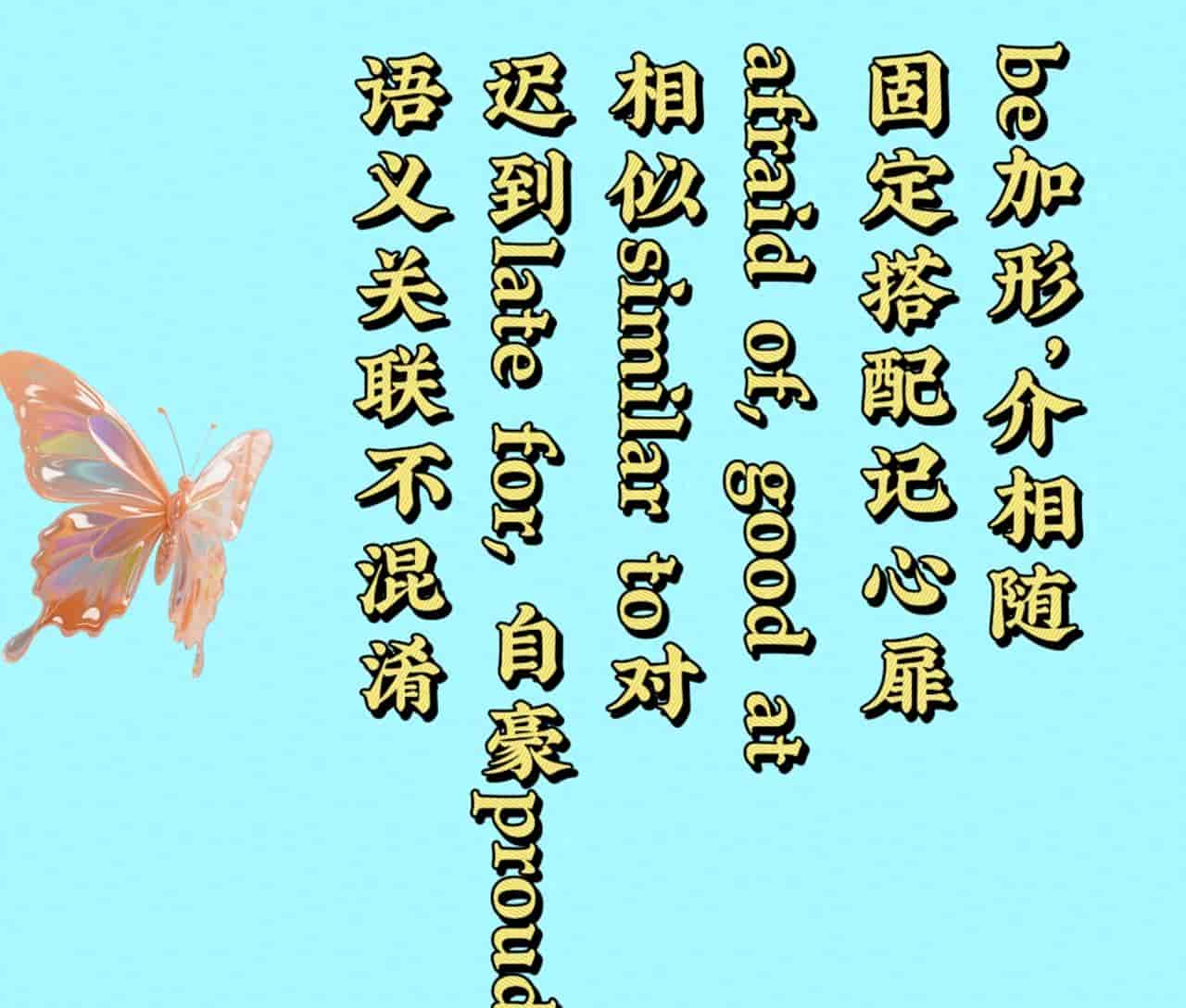
四、记忆口诀
“be加形,介相随,固定搭配记心扉;
afraid of, good at,类似similar to对;
迟到late for, 自豪proud of,语义关联不混淆。”
“be+形容词+介词”结构的核心是”固定搭配+语义逻辑”,通过分类记忆(如态度类、关系类)和真题练习,可快速掌握高频搭配,避免常见错误,让表达精准规范。
© 版权声明
文章版权归作者所有,未经允许请勿转载。
相关文章



暂无评论...