
hum=earth,表明“土,地”
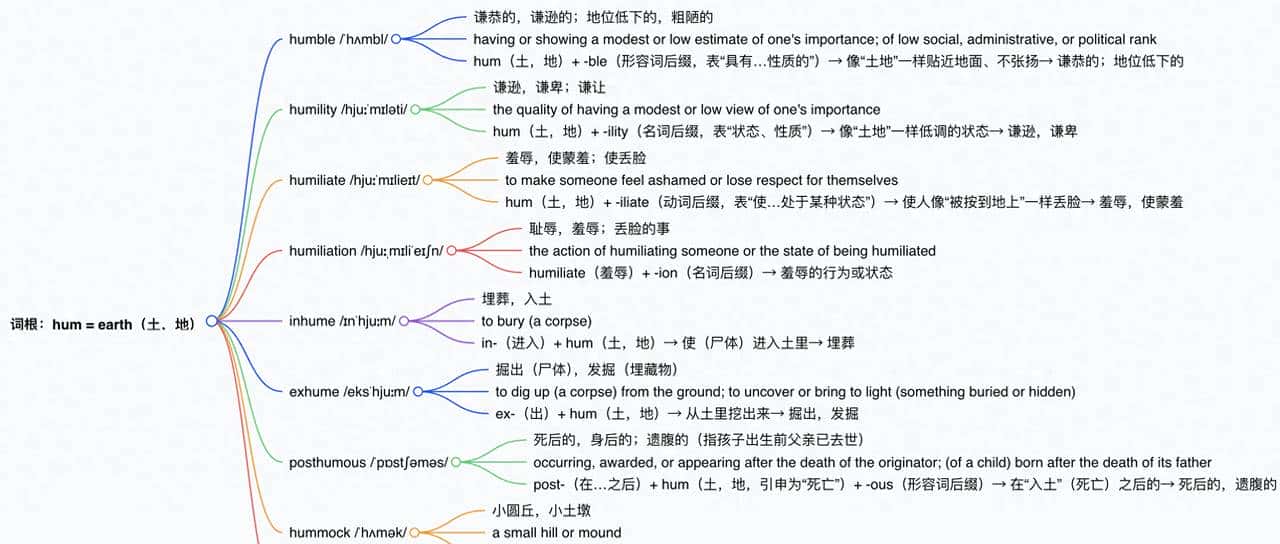
- humble /ˈhʌmbl/
中文释义:谦恭的,谦逊的;地位低下的,粗陋的。
英文释义:having or showing a modest or low estimate of one's importance; of low social, administrative, or political rank.
构词:hum(土,地)+ -ble(形容词后缀,表 “具有… 性质的”)→ 像 “土地” 一样贴近地面、不张扬→ 谦恭的;地位低下的。
例句:He is a humble man who never boasts about his achievements.(他是个谦逊的人,从不炫耀自己的成就。);They lived in a humble cottage in the countryside.(他们住在乡下一间简陋的小屋里。) - humility /hjuːˈmɪləti/
中文释义:谦逊,谦卑;谦让。
英文释义:the quality of having a modest or low view of one's importance.
构词:hum(土,地)+ -ility(名词后缀,表 “状态、性质”)→ 像 “土地” 一样低调的状态→ 谦逊,谦卑。
例句:Her humility and kindness won her many friends.(她的谦逊和善良为她赢得了许多朋友。) - humiliate /hjuːˈmɪlieɪt/
中文释义:羞辱,使蒙羞;使丢脸。
英文释义:to make someone feel ashamed or lose respect for themselves.
构词:hum(土,地)+ -iliate(动词后缀,表 “使… 处于某种状态”)→ 使人像 “被按到地上” 一样丢脸→ 羞辱,使蒙羞。
例句:The teacher’s harsh words humiliated the student in front of the class.(老师严厉的话语让那个学生在全班面前蒙羞。) - humiliation /hjuːˌmɪliˈeɪʃn/
中文释义:耻辱,羞辱;丢脸的事。
英文释义:the action of humiliating someone or the state of being humiliated.
构词:humiliate(羞辱)+ -ion(名词后缀)→ 羞辱的行为或状态。
例句:He couldn’t bear the humiliation of being fired in front of his colleagues.(他无法忍受在同事面前被解雇的耻辱。) - inhume /ɪnˈhjuːm/
中文释义:埋葬,入土。
英文释义:to bury (a corpse).
构词:in-(进入)+ hum(土,地)→ 使(尸体)进入土里→ 埋葬。
例句:The ancient tribe would inhume their dead with special rituals.(这个古老部落会用特殊仪式埋葬死者。) - exhume /eksˈhjuːm/
中文释义:掘出(尸体),发掘(埋藏物)。
英文释义:to dig up (a corpse) from the ground; to uncover or bring to light (something buried or hidden).
构词:ex-(出)+ hum(土,地)→ 从土里挖出来→ 掘出,发掘。
例句:The archaeologists plan to exhume the ancient tomb to study the artifacts inside.(考古学家计划发掘这座古墓,研究里面的文物。) - posthumous /ˈpɒstʃəməs/
中文释义:死后的,身后的;遗腹的(指孩子出生前父亲已去世)。
英文释义:occurring, awarded, or appearing after the death of the originator; (of a child) born after the death of its father.
构词:post-(在… 之后)+ hum(土,地,引申为 “死亡”)+ -ous(形容词后缀)→ 在 “入土”(死亡)之后的→ 死后的,遗腹的。
例句:The author’s posthumous novel was published two years after his death.(这位作家的遗作在他去世两年后出版了。);She was a posthumous child—her father died before she was born.(她是遗腹子,父亲在她出生前就去世了。) - hummock /ˈhʌmək/
中文释义:小圆丘,小土墩。
英文释义:a small hill or mound.
构词:hum(土,地)+ -mock(表 “块状、圆丘状物体” 的后缀)→ 由土构成的小圆丘→ 小土墩。
例句:The field was covered with grassy hummocks that made walking difficult.(这片田野布满了长满草的小圆丘,行走很困难。) - humus /ˈhjuːməs/
中文释义:腐殖质(土壤中由动植物腐烂形成的有机物质)。
英文释义:dark organic material in soils, formed from the decomposition of dead plants and animals.
构词:hum(土,地)+ -us(名词后缀,表 “物质”)→ 与 “土壤” 相关的有机物质→ 腐殖质。
例句:Humus enriches the soil and helps plants grow better.(腐殖质能肥沃土壤,协助植物更好地生长。)
备注说明:
- 词根核心关联:
牢牢抓住 “hum=earth(土,地)” 的核心含义,所有单词均围绕 “土” 的本义或引申义(如 “入土 = 死亡”“贴近土地 = 谦逊”)展开的:
表 “谦逊、羞辱”:因 “土地” 低调、贴近地面,引申为 “不张扬”(humble),反向则为 “使人贴近地面般丢脸”(humiliate);
表 “埋葬、发掘”:直接关联 “土” 的动作,如 “入土”(inhume)、“出土”(exhume);
表 “土地相关事物”:如 “小土丘”(hummock)、“土壤有机物”(humus)。 - 易混淆词区分:
“inhume” vs “exhume”:前者是 “把… 埋进土里”(埋葬),后者是 “把… 从土里挖出来”(掘出),前缀 “in-(进入)” 和 “ex-(出)” 是关键区分点;
“humble”(形容词,“谦逊的”)vs “humility”(名词,“谦逊”):注意词性差异,如 “a humble person”(谦逊的人)、“show humility”(表现出谦逊)。 - 发音与拼写提示:
“posthumous” 发音易误读,注意 “post-” 在此处发 /ˈpɒst/,而非 /ˈpəʊst/,整体音标为 /ˈpɒstʃəməs/;
“humus” 拼写易与 “humus”(注意无重复字母)混淆,结合 “土壤有机物质” 的含义记忆,避免漏写或多写字母。 - 语境适配注意:
“posthumous” 修饰 “作品、奖项” 时表 “死后发表 / 颁发”,修饰 “孩子” 时特指 “遗腹子”,需结合语境判断,避免歧义;
“inhume” 和 “exhume” 均为正式书面语,日常语境中更常用 “bury”(埋葬)和 “dig up”(掘出),仅在学术、法律或文学语境中高频出现。
© 版权声明
文章版权归作者所有,未经允许请勿转载。
相关文章







兄台,你真励害