【本文内容】
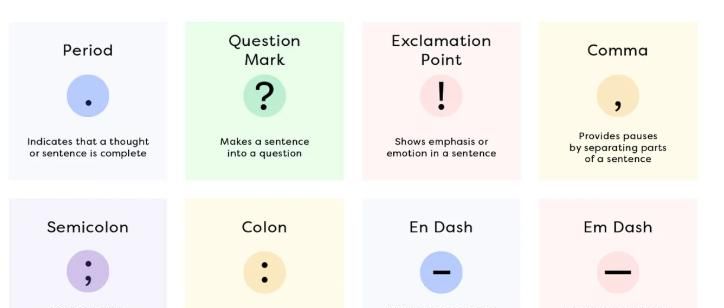
- 英语标点概述
- Period ( . )
- Question Mark ( ? )
- Exclamation Point ( ! )
- Comma ( , )
- Semicolon ( ; )
- Colon ( : )
- Em Dash ( — )
- En Dash ( – )
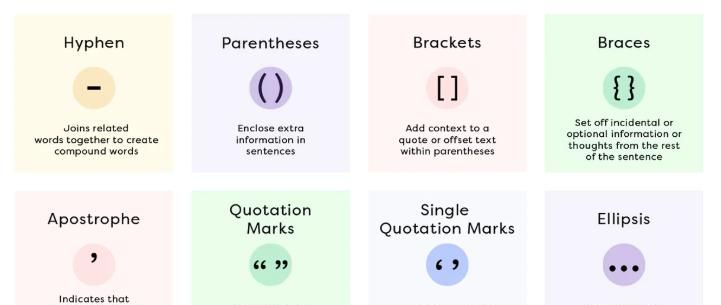
- Hyphen ( – )
- Parentheses ( )
- Brackets [ ]
- Braces { }
- Apostrophe ( ‘ )
- Quotation Marks (“ ”)
- Sile Quotation Marks (‘ ’)
- Ellipsis (…)
- 中英文标点异同
1.Period ( . )
用法:用于句子的结尾,表明语句的结束。常用于陈述句或命令句中。
- She loves books.
她喜爱书。 - I am going home.
我要回家了。
2.Question Mark ( ? )
用法:用于疑问句的结尾,表明提问。
- What time is it?
目前几点? - Are you coming with us?
你和我们一起来吗?
3.Exclamation Point ( ! )
用法:用于表达强烈情感、惊讶、命令、呼喊或感叹的句子末尾。
- Wow! That’s amazing!
哇!太棒了! - Hurry up! We are going to be late!
快点!我们要迟到了! - I can't believe it!
我简直不敢信任!
4.Comma ( , )
用法:用于分隔句子中的并列成分、从句或短语。也用于列表中的项之间。
- I bought apples, oranges, and bananas.
我买了苹果、橙子和香蕉。 - She is intelligent, kind, and hardworking.
她既机智,又善良,工作努力。 - After the meeting, we went for lunch.
会议结束后,我们去吃午饭。
5.Semicolon ( ; )
用法:用于连接两个独立的句子,尤其是当这两个句子紧密相关时。也可用于复杂的列表中分隔各项。
- She loves reading; her brother prefers playing sports.
她喜爱读书;她哥哥喜爱运动。 - I went to the store; however, they were out of stock.
我去了商店;不过,他们的货已售罄。 - We visited Paris, France; Rome, Italy; and Madrid, Spain.
我们参观了法国巴黎、意大利罗马和西班牙马德里。
6.Colon ( : )
用法:用于引出列表、说明、解释或补充信息。一般在一个完整的句子后面。
- She brought the following items: a notebook, a pen, and some paper.
她带来了以下物品:一本笔记本、一支钢笔和一些纸。 - There is one rule: always be honest.
有一条规则:永远要诚实。 - He said: “I will be there in five minutes.”
他说:“我五分钟后到。”
7.Em Dash ( — )
用法:用于插入额外信息或说明,或者表明句子中的突然转折或停顿。它比逗号、冒号更具强调作用。
- She was late—again!
她又迟到了——真是的! - He gave me the book—a gift for my birthday.
他给了我这本书——是我生日的礼物。 - The meeting was delayed—no one knew why.
会议被推迟了——没人知道为什么。
8.En Dash ( – )
用法:表明连接范围、时间段、日期等。它的长度比短破折号稍长,但比长破折号短。
- The meeting is scheduled from 9:00 a.m. – 5:00 p.m.
会议安排在上午9点到下午5点之间。 - The London–Paris flight is delayed.
伦敦到巴黎的航班被延误了。 - We are open Monday–Friday.
我们周一至周五营业。
9.Hyphen ( – )
用法:用于连接复合词、分割词或音节。
- She is a well-known author.
她是著名的作家。 - I need a ten-minute break.
我需要十分钟的休憩。 - The high-speed train is efficient.
高速列车超级高效。
10.Parentheses ( )
用法:用于插入额外信息、解释或补充说明,一般不会影响句子的基本结构。
- The conference (which was held last week) was a success.
会议(上周举行)超级成功。 - He loves pizza (especially pepperoni).
他喜爱披萨(尤其是意大利辣香肠)。 - We will arrive at 6 p.m. (weather permitting).
我们将在下午6点到达(如果天气允许的话)。
11.Brackets [ ]
用法:用于插入解释或补充信息,尤其是在引用中对原文进行修改或添加。
- He said, “I will go [to the store] after work.”
他说:“我下班后去[商店]。” - The report (which was completed yesterday) was very detailed.
这份报告(昨天完成)超级详细。 - She didn’t like the movie [it was too slow].
她不喜爱那部电影[它太慢了]。
12.Braces { }
用法:常用于数学表达式、编程语言中表明集合,或在列举多个选项时使用。在英语写作中较少使用。
- The set contains the numbers {1, 2, 3}.
这个集合包含数字{1, 2, 3}。 - Use the braces to group the following options: {a, b, c}.
使用大括号来分组以下选项:{a, b, c}。
13.Apostrophe ( ‘ )
用法:用于表明所有格(表明某物属于某人或某物),或在缩写中表明省略的字母。
- It's John's book.
这是约翰的书。 - I can't believe it!
我简直不敢信任! - The cat's tail is fluffy.
那只猫的尾巴很蓬松。
14.Quotation Marks (“ ”)
用法:用于直接引用他人说的话或标出书名、文章标题等。
- She said, “I will be there soon.”
她说:“我很快就到。” - “Where are you going?” he asked.
他问:“你要去哪儿?” - The article is titled “The Future of AI.”
这篇文章的标题是《人工智能的未来》。
15.Single Quotation Marks (‘ ’)
用法:一般用于引语中的引语或表明某些特定的含义。例如,英国英语在直接引语中使用单引号。
- He said, 'I will go to the store later.'
他说:“我稍后去商店。” - She asked, 'Is it time for dinner?'
她问:“该吃晚餐了吗?” - The term 'quantum leap' refers to a significant change.
“量子飞跃”一词指的是一个重大的变化。
16.Ellipsis (…)
用法:表明省略的部分、未完的语句、或表明思考的停顿。
- I’m not sure… maybe we should wait.
我不确定……也许我们应该等一下。 - He looked at me and said, “I don’t know… maybe.”
他看着我说:“我不知道……也许吧。” - “Well…” she paused, “I guess we have no choice.”
“嗯……”她停顿了一下,“我想我们别无选择。”
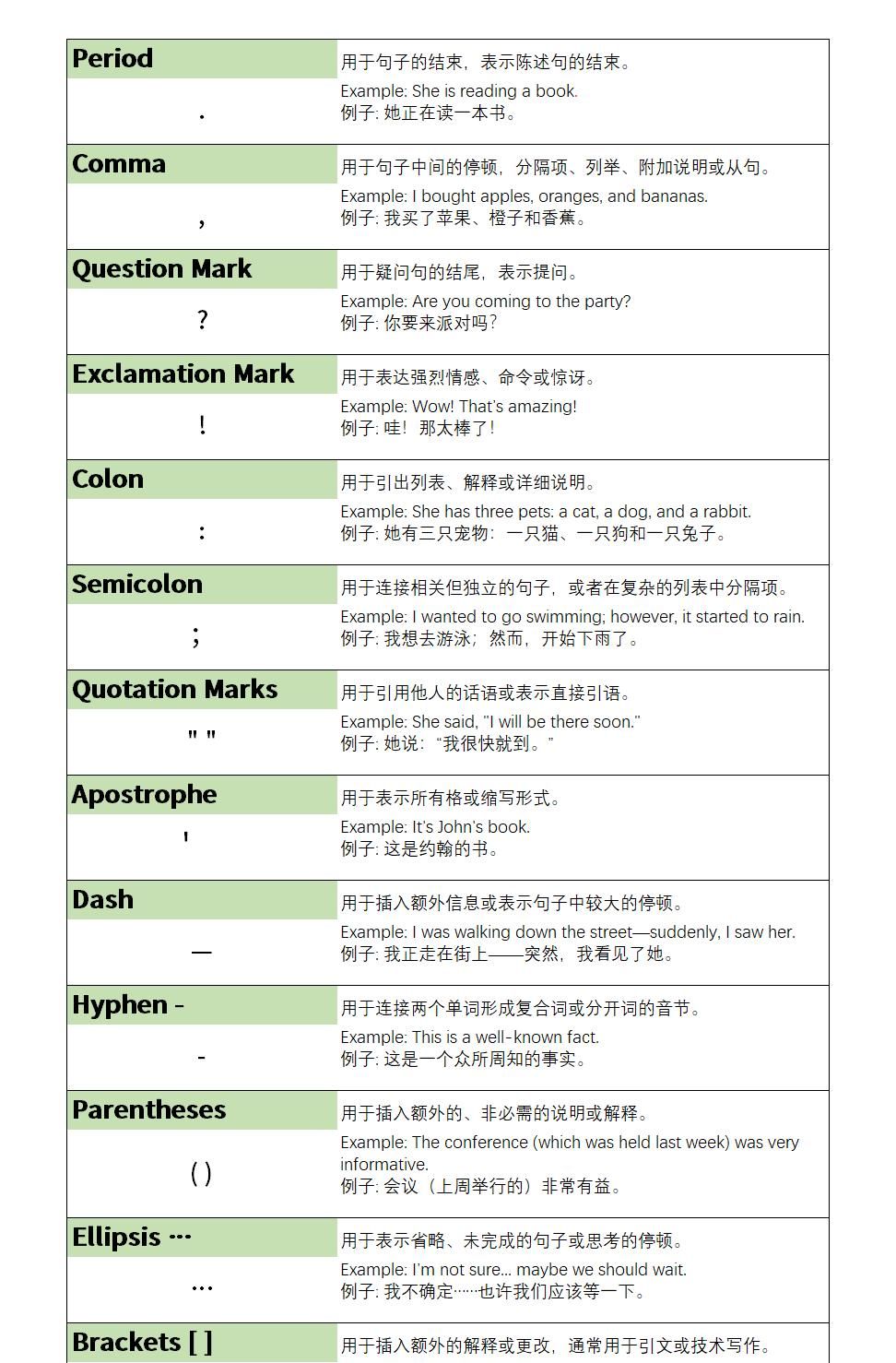
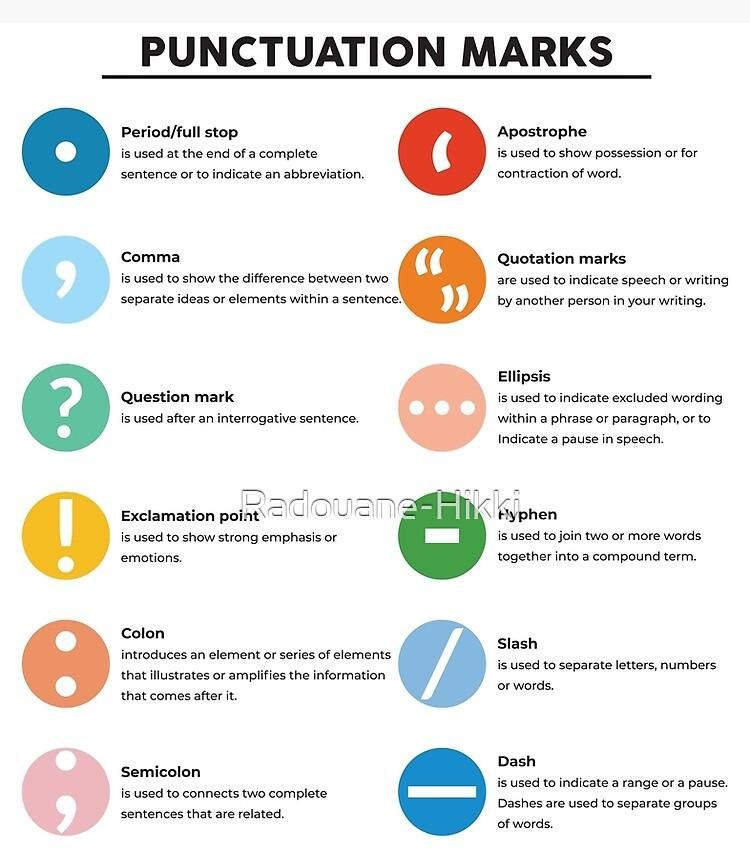
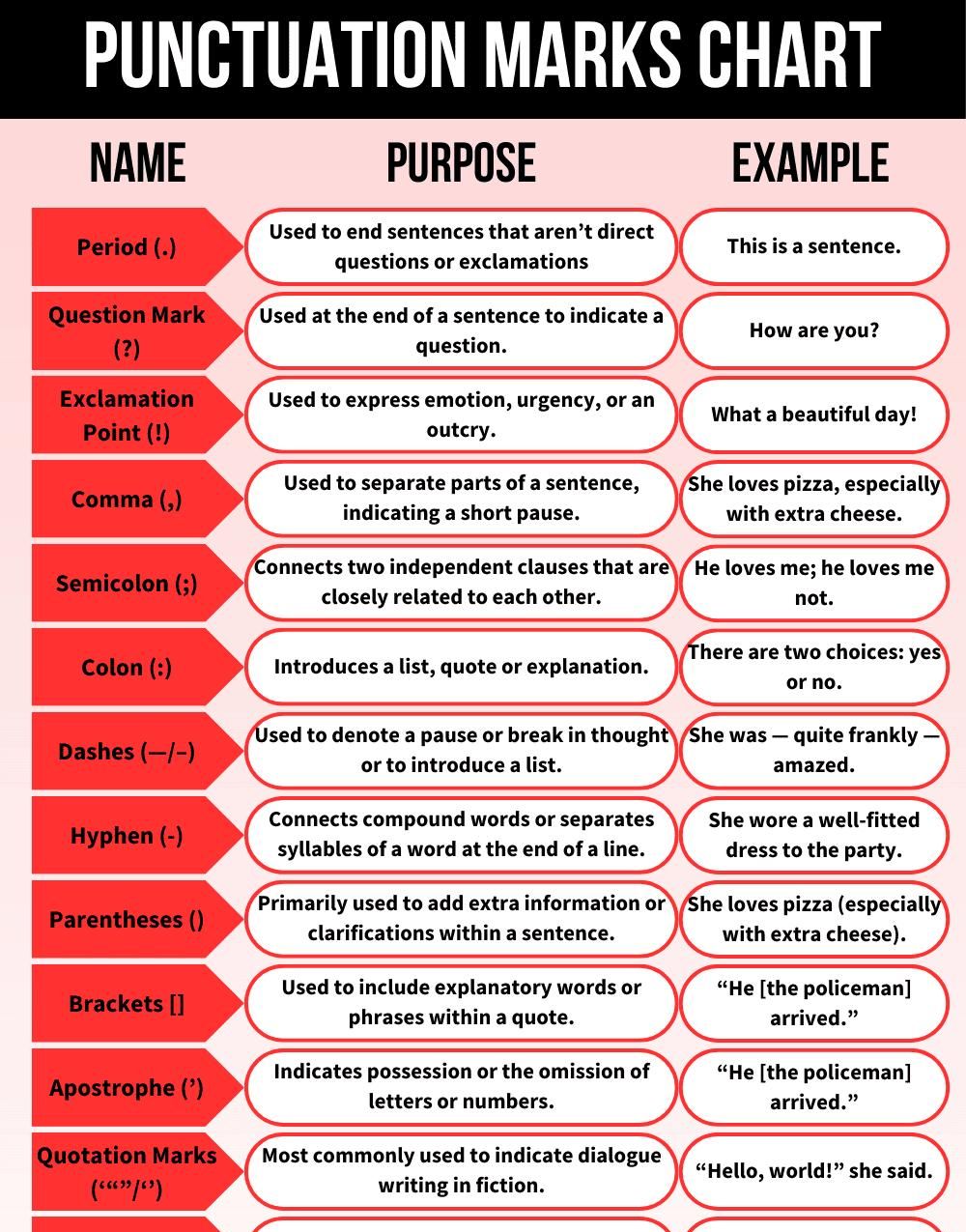
Although Chinese and English punctuation marks have more similarities than differences, there are also many differences between Chinese and English punctuation marks. Here are the similarities and differences between Chinese and English punctuation:
虽然汉语和英语标点符号的类似之处多于不同之处, 但是中英文标点符号也有不少区别。以下是中英文标点的异同点:
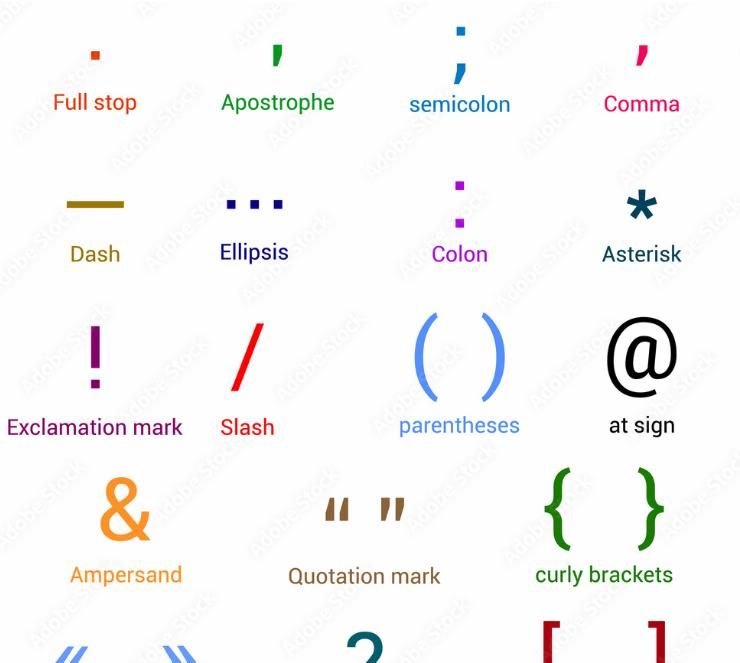
1 句号 (Period)
中英文都使用句号表明陈述句的结束,表明一句话的终结。
写法有所不同:中文句号是一个小圆圈(。),而英文句号则是一个实心点(.)
- She enjoys reading.
- 她喜爱读书。
- He is my friend.
- 他是我的朋友。
- They went to the park.
- 他们去了公园。
2 书名号 (《》)
中文使用书名号(《》)来标识书名、文章名、电影名等;
英文则一般使用斜体、大写或引号来表明。
- 我正在读《活着》。
- I am reading To Live.
3 引号 (Quotation Marks)
中文引号(“ ”)和英文引号(” “)在引语内标点符号的位置以及引语套用时的顺序上,中英文也有所不同。
- She said, “I will be there soon.”
- 她说:“我很快就到。”
- “Where are you going?” he asked.
- 他问:“你要去哪儿?”
- The teacher said, “Please hand in your assignments.”
- 老师说:“请交上你们的作业。”
单引号 (Single Quotation Marks)一般用于以下几种情况:1) 引用句子中的引语(尤其是在英国英语中)。2) 用于表明词语或短语的特殊含义或用法。3)引用某些特别的术语或在编程语言中。
- She asked, 'Is it time for dinner?'
她问:“该吃晚餐了吗?” - The word 'hyperbole' means exaggerated statements.
“夸张”一词意味着夸大其词。 - You can define the variable 'x' to store the number.
你可以定义变量“x”来存储数字。
双引号 (Double Quotation Marks)一般用于以下几种情况:1)直接引用他人的话。2)引用书名、文章标题、电影名等。3)强调某个词或短语。
- She said, “I will be there in ten minutes.”
她说:“我十分钟后到。” - She said, “I will be there in ten minutes.”
- 她说:“我十分钟后到。”
- He is known for his “out-of-the-box” thinking.
- 他以“跳出框架”的思维而闻名。
4 省略号 (Ellipsis)
中文省略号(……)是六个点;
英文省略号(…)一般是三个点。
- I’m not sure… maybe we should wait.
- 我不确定……也许我们应该等一下。
- He looked at me and said, “I don't know… maybe.”
- 他看着我说:“我不知道……也许吧。”
- “Well…” she paused, “I guess we have no choice.”
- “嗯……”她停顿了一下,“我想我们别无选择。”
5 顿号 (、)
中文使用顿号(、)来分隔并列的词语或短语,特别是在列举时;
英文没有类似的符号,一般使用逗号或连词来分隔。
- I bought apples, oranges, and bananas.
- 我买了苹果、橙子和香蕉。
- She is kind, intelligent, and hardworking.
- 她既善良,又机智,工作努力。
6 撇号;省字符; 省略符号 (Apostrophe)
- It's John's book.
- 这是约翰的书。
- I can't find my keys.
- 我找不到我的钥匙。
- The cat's tail is fluffy.
- 那只猫的尾巴很蓬松。
© 版权声明
文章版权归作者所有,未经允许请勿转载。







收藏了,感谢分享